
A civil war in hyperreality
Baudrillard, propaganda 2.0, and the manufacturing of a simulated British "civil war"

In an episode of Don’t Hug Me I’m Scared1, a horror-comedy adult puppet show, Duck reads a newspaper report that he is dead. As a result, his friends help bury him in a coffin, convinced that he is deceased, despite his animated state.
A similar situation is common with readers of Being You2, a bestseller about neuroscience and consciousness. Anil Seth, the author, insists that everything about us is ultimately mechanical. Readers come away from the book believing that all their loves, fears, memories, hopes, dreams, and even present experiences, are merely delusions that can be comprehensively betokened by some sign or set of signs in their mind’s eye; perhaps neurons flashing with electricity, or little blobs shooting out of synapses, or Daniel Dennett’s myriad tiny robots3, or grey billiard balls in a dark void, or even one-dimensional strings vibrating in ten dimensions (which in one’s imagination are perhaps something like smoke rings with a shimmering iridescence).
It takes a particular kind of vulnerability on the part of the reader when, in unquestioning deference to the authority of the author, the weight of his entire life and being, every moment of experience, every cherished memory, every existential ache, can be borne by these flimsy signs. It’s a testament to our dogmatic dedication to the hylomaniac Zeitgeist that so many of us can be strung along by simulations such as this.
If we can be so effortlessly convinced into outsourcing the reality of our being, our most intimate seemings, to these gossamer signs, what else can we be led to believe? How else can superficial signs substitute present, authentic being? When we accept our own being and humanity as merely a mechanical delusion, we lose the rootedness required for resisting insidious simulations with cynical motivations behind them.
What if, despite the peace and quiet on our doorstep, we can be led into believing that there is a war going on out there? What if our map of “war” becomes so overflowing with fantastic detail that the ink spills far beyond the distant territories it currently traces? What if it spreads so far that, when being cheerfully greeted by one’s neighbour, one imagines that what’s really happening is the most brutal of conflicts?
The philosopher Jean Baudrillard identified our society as “hyperreal”4. “Hyperreality” arises when people are no longer able to distinguish reality from fantasy. He described our culture as being dominated by simulations, systems of signs where the signs constitute “pure simulacra”, entirely untethered from any original grounding.
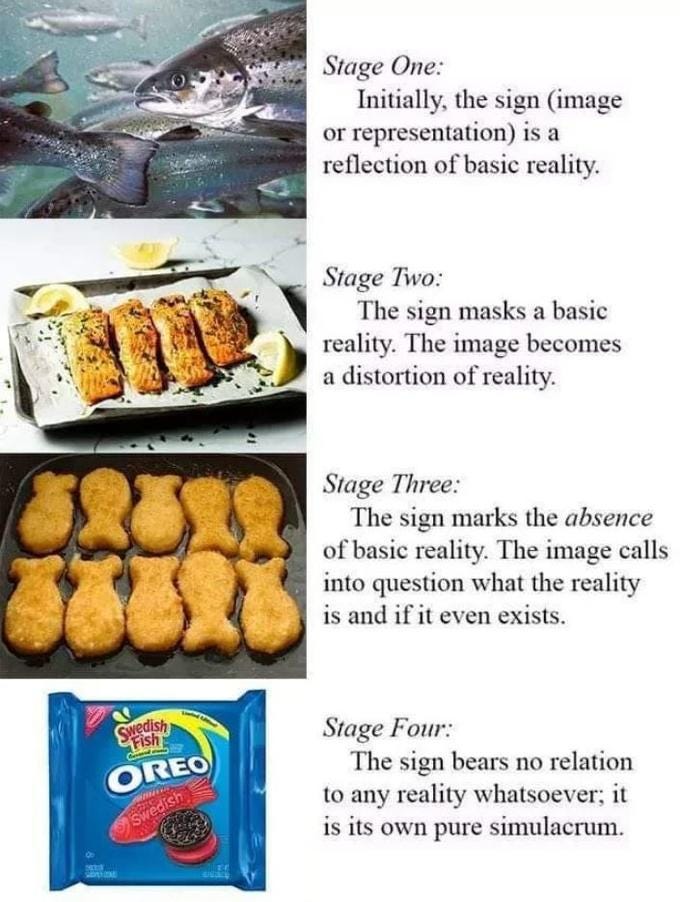
Baudrillard identified simulacra as existing in four stages5. For example:
In the first stage, we catch a fish in a river, see it writhing in our net, feel it slipping in our hands before we despatch it with a hard blow.
In the second stage, we are served fillets of sautéed fish, ready to be consumed immediately. The neatly prepared sign obscures the writhing fish in the net.
In the third stage, we eat reconstituted fish meat formed into breadcrumbed fish-shaped patties. That there ever was a writhing fish in a net, at some point in their production, seems strange now. Their fish-like shape seems far more true and present than any actual fish.
In the fourth stage, we treat our children to Oreos with a Swedish Fish-flavoured filling, a product where “fish” as a sign has no relation to actual fish at all, and no meaning beyond itself. The sign has become its own pure simulacrum.
Most pertinent to this essay are Baudrillard’s incendiary essays on the Gulf War,6 where he elucidates its life in the Western world: a cloud of images, phrases, and narratives with little to no relation to life on the ground. For Baudrillard, the Gulf War was never experienced in any kind of authenticity; instead, it lit up TV screens and vibrated through speaker cones in the form of a heavily sanitised simulation, a virtual spectacle masking an industrialised elimination of hundreds of thousands of Iraqis, while the US suffered just 148 losses from hostile causes out of half a million troops,7 a figure similar to the number that would have died in traffic accidents had they stayed at home,8 an asymmetry that one wouldn’t naturally think constitutive of a “war”. The closest the public came to the events was watching green-tinted night vision and thermal camera feeds. Yet these technological interfaces are themselves a virtual barrier to the authentic.
Baudrillard wasn’t making a geopolitical case; he wasn’t concerned with whether the war was justified. What he was bringing attention to was how lost we have become in feedback loops of free-floating signs, such that we only become more tangled up in this hyperreality when we are fed information about something as brutally serious as the events in the Gulf.
Baudrillard hasn’t been alone in making this kind of analysis, nor has it solely been the province of subversive philosophers. In 2008, King’s College London published an essay called “The virtual dimension of contemporary insurgency and counterinsurgency”, by David Betz.9
Whereas Baudrillard was pessimistic about society losing itself in cybernetic systems of free-floating signs, Betz argues that it has not become hyperreal enough. He insists that Western states should use more sophisticated propaganda techniques that render it more difficult to discern when messages are coming from state actors. In essence, he is advocating for the manufacturing of consent by consensus cracking and astroturfing campaigns. He declares:
New times call for new means: fighting a ‘war of ideas’ in Web 2.0 means mastering what one might call Propaganda 2.0.
What Betz advocates with “Propaganda 2.0” is not merely a new channel of broadcasting, but the weaponisation of the platform itself. The internet functions as a one-way mirror, effectively acting as a digital adaptation of Jeremy Bentham's panopticon.10 In Bentham's prison design, inmates are isolated in cells encircling a central watchtower, never knowing exactly when they are being observed. In the internet realm, the screen that flashes with hyperreal spectacle is part of the very same apparatus that watches us. When frittering away time in online spaces, we willingly dwell in the panopticon's cells, conditioned by the architecture itself to perpetuate the simulation.
Betz notes that the public have become more trusting of (what they perceive as) alternative media, while far more suspicious of traditional channels. This has only become more true in the time since 2008, even though much media perceived as “alternative” is now mainstream, while no one watches traditional media (traditional broadcasters can only dream of the viewing figures that top podcasts boast). Betz goes on to say that:
J. Michael Waller11 … argues that words and images are vital strategic weapons which the West under- or poorly employs. In this he is entirely correct.
And how should the West better employ these “strategic weapons”? One option is astroturfing comment sections:
Popular websites from YouTube through BBC News and most major newspapers offer mechanisms by which readers can comment on articles or videos and influence how prominently items are represented. This is not to say that such comments necessarily affect the decisions of the editors of these papers; rather they influence the perception of readers of those articles and comments in ways in which the editor may not have intended or considered.
Betz concludes by writing:
What is required in the virtual dimension is the power to persuade, to purposefully shape the beliefs of others for one’s own objectives.
The Department of War Studies at King’s College London is intimately connected with the UK’s military apparatus, so perhaps it should come as no surprise that two years after Betz’s essay was published, the British Army launched what is now called the 77th Brigade,12 a group of professional keyboard warriors who manufacture popular consent for the state’s aims. Using the very methods that Betz was advocating, they pose as ordinary internet users in social media feeds, comment sections, and topic threads across the internet, and push whatever narrative the state wishes to give currency to.
A couple of years ago, Military Strategy Magazine, a niche publication with no academic standing, printed another essay by Betz.13 The magazine’s publisher, IJ Group, is based in Tel Aviv, and its founder, Dr A.E. Stahl,14 served as a Research Fellow at the International Institute for Counter-Terrorism in Herzliya.15 The ICT specialises in shaping narratives and is deeply embedded in the Israeli security apparatus, renowned for cutting-edge surveillance techniques and highly sophisticated information warfare. The magazine's Editor-in-Chief, William F. Owen, is an Intelligence Corps veteran.16
The essay is titled “Civil War Comes to the West", and Betz expresses a line of argument that he has broadcast on numerous “alternative” media platforms,17 namely very popular podcasts that in truth constitute the new mainstream, and are often under the sway of massive corporations and the billionaire class. Betz tends to highlight genuine problems we face in this country, such as political divides, classism, religious and ethnic tensions, increasing poverty, and frictions between immigrant and indigenous populations. In other words, dynamics one hardly needs a PhD to be aware of. He then whips out some numbers and calculates how likely a civil war is. But his main strategy is to fit the term “civil war” to almost any scenario.
In reference to Humpty Dumpty in Lewis Carroll’s Through the Looking-Glass, the philosopher Galen Strawson coined the term “looking-glassing”.18 In the book, the character uses words entirely incorrectly, but he insists that “When I use a word, it means just what I choose it to mean — neither more nor less.”19 “Looking-glassing” hence denotes the act of shifting the meaning of a term to suit one’s whims. In the spirit of the sophisticated propaganda he advocates, Betz cleverly looking-glasses the term “civil war”, such that any unrest, even a few blokes throwing wheelie bins around in Plymouth, constitutes civil war. Indeed, according to Betz, in the UK civil war isn’t merely on the horizon, it’s already happening.20
Despite all appearances; despite the UK being one of the safest, most stable nations in the world, with seasoned institutions that are, by international standards, exceptionally shockproof; despite a populace rendered utterly bovine by endless doom-scrolling, Netflix, consecutive sport tournaments, mobile games, parasocial relationships, podcasts, co-opted academia, porn, and middle-rate fiction novels; despite a surveillance state that Edward Snowden claims is the most intrusive, sophisticated, and extensive in the history of the world;21 despite civilians having no firearms while the army has swarms of cutting-edge drones and directed energy lasers; despite networks of myriad Deliveroo cyclists delivering any and every cuisine to your door in minutes; despite the fact that, relative to other societies in history, atrocities stir up remarkably feeble reactions (consider London in 1809, when a slight hike in opera ticket prices led to 64 days of rioting22), we are, according to Betz, in a civil war.
Perhaps Betz’s evaluation can be fully explained by the old adage, “to a man with a hammer, everything looks like a nail.” But given his background, I can’t help wondering if another explanation might be more fitting. Betz has served as an advisor to GCHQ, the MoD, and has served as Project Lead for the U.S. DoD Minerva Initiative,23 described by one anthropologist as an “attempt to centralize thinking about culture and terrorism under the Pentagon's roof”.24 He’s also taught Informational Warfare at the UK Defence Academy and contributed to an MoD Joint Doctrine Publication (JDP 3-40) that advocates for coordinated efforts to psychologically condition the public.25
Earlier this year, our Home Secretary, Shabana Mahmood, stated the following:
AI and technology can be transformative to the whole of the law and order space. When I was in justice, my ultimate vision for that part of the criminal justice system was to achieve, by means of AI and technology, what Jeremy Bentham tried to do with his Panopticon. That is that the eyes of the state can be on you at all times. Similarly, in the world of policing, in particular, we’ve already been rolling out live facial recognition technology, but I think there’s big space here for being able to harness the power of AI and tech to get ahead of the criminals, frankly, which is what we’re trying to do.26
A simulated, virtual civil war is the perfect spectacle for bringing about this Benthamite fever dream. In Britain, the notion of a brick through the window provokes the deepest of fears. The harsh realities of cold, damp air whistling through the shattered pane, the neighbours talking, and the rigmarole of sorting it out, are bad enough. But worst of all is the breaking of the barrier between the privacy of the home and the world outside. It’s something to be avoided at all costs. Freedoms may be curtailed, curfews may be enforced, lives may be constantly surveilled, whole cities locked down, just so long as bricks don’t fly through windows.
A simulated civil war, a violent spectacle sans any actual threat to the system, is an excellent way of stirring the British into supporting the state tightening its grip on the public. It is a conflict that is always happening just a few streets away, that lives as footage indistinguishable from AI video and AI video indistinguishable from footage, that spirals into a whirlwind of conflicting signs perfectly engineered to set pulses racing and teeth gnashing. Perhaps there can even be a “storming of the Bastille” moment reconstituted as a virtual dream: Instagram photos and TikTok videos of cretins breaking into Westminster, who then have no better idea of what to do than take selfies and micturate on hardwood desks. Perhaps there can be impassioned, noisy debates about rumours of agents provocateurs and foreign influence. Perhaps there can be endless statistics and all sorts of charts and numbers, glowing with more truthiness than any experience on the street, showing just how many bins have been set on fire and bricks thrown through windows.
Most enticing of all is that it allows people to cheer on their side without ever having to actually do anything except post feverish diatribes on social media, and feel satisfied that they are “doing their part”. Already in the UK the anti-immigration crew will cheer on politicians who let in far more immigrants than the opposition, as they did with Boris Johnson, who oversaw the largest wave of immigration in the entirety of British history, and by an absolutely enormous margin.27
But this didn’t matter, because what mattered was the simulation. Within the system of signs, Johnson represented the anti-immigration signs, and that’s all that was relevant. By cheering him on, one was supporting this and opposing the pro-immigration signs. The fact that these signs were completely untethered from any reality didn’t matter at all. One was solely concerned with appearing to oppose the pro-immigration crew, who were no less taken in by Johnson’s anti-immigration pantomime act. What each side wanted most was to spite the other, or at least spite the caricature, the simulacrum, they perceived the other to be. In the simulated civil war, this dynamic can be brought to its logical conclusion, and we can all find new purpose in our lives by fully dedicating ourselves to spiting the caricatures we are fed via the various virtual realms we inhabit.
Indeed, Betz’s claim that the civil war is already here seems plausible, if by “here” we mean the hyperreal realm. Even before Betz’s claims gained currency, 32% of British people believed civil war would break out in the next ten years,28 and it’s no wonder, given that the cultural landscape is saturated with titillating pornography on the theme, like Alex Garland’s Civil War (2024),29 Indeed, one prominent British journalist has even indulged in the drama of packing up and fleeing the country,30 after Mr. Betz featured on her podcast and hooked her up to his thrilling technicolour civil war simulation.31 Additionally, one can’t ignore a historical context of perennial screeching about civil war being near, for example in 1912 over the Irish Home Rule Crisis, in 1926 over the General Strike, in the 1930s over the fascism vs. communism battle, and throughout the ‘60s, ‘70s, and ‘80s, as the immigration debate, The Troubles, and the miner’s strikes caused deep rifts.
Of course, the civil war simulation will churn things up beyond its cybernetic system, such that a few people will inevitably get hurt and even killed. But the dead will be swept up into the storm of simulacra, finding new life in stirring narratives, ironic memes, t-shirts emblazoned with their faces, bumper stickers, TV dramatisations, deepfakes, placards, “quotes” from family members, and salacious rage-bait.
Now that all the blood has been drained out of life, and we live as atomised, lonely, disenfranchised, disaffected, immobilised "individuals" fattened up on ultra-processed goop vomited out of distant factories; now that we all "know" that we’re nothing but heaps of particles, delusional meat-puppets who read The Divine Comedy for purely mechanical reasons yet trick ourselves into feeling it’s profound; now that we are provably worthless because Betelgeuse is so incredibly big and the universe so incredibly old; now that we have been so comprehensively conditioned into accepting all of these things, to the point where we don’t even notice they’re spurious beliefs and value judgements, what better way to bring a little zest to our lives than to be thrilled by the drama of a simulated civil war in hyperreality?
Sloan, Becky, Joe Pelling, and Baker Terry, creators. “Death.” Don’t Hug Me I’m Scared (TV Series), Season 1, Episode 2, September 23, 2022. https://donthugme.fandom.com/wiki/Death.
Seth, Anil. Being You: A New Science of Consciousness. London: Faber & Faber, 2021.
Dennett, Daniel C. Freedom Evolves. London: Penguin, 2004, 13.
Baudrillard, Jean. Simulacra and Simulation. Translated by Sheila Faria Glaser. Ann Arbor: University of Michigan Press, 1994.
Ibid.
Baudrillard, Jean. The Gulf War Did Not Take Place. Translated by Paul Patton. Bloomington: Indiana University Press, 1995.
Department of Defense. Conduct of the Persian Gulf War: Final Report to Congress. Washington, D.C.: Department of Defense, April 1992. https://apps.dtic.mil/sti/tr/pdf/ADA249390.pdf.
National Highway Traffic Safety Administration. Fatal Accident Reporting System 1991. DOT HS 807 954. Washington, D.C.: U.S. Department of Transportation, 1993.
Betz, David. “The Virtual Dimension of Contemporary Insurgency and Counterinsurgency.” Small Wars & Insurgencies 19, no. 4 (2008): 510-540.
Bentham, Jeremy. Panopticon; or, The Inspection-House. London: T. Payne, 1791.
Waller, J. Michael. Fighting the War of Ideas like a Real War. Washington, D.C.: Institute of World Politics Press, 2007. https://www.thriftbooks.com/w/the-public-diplomacy-reader_j-michael-waller/1502182/.
MacAskill, Ewen. “British army creates team of Facebook warriors.” The Guardian, January 31, 2015.
Betz, David. “Civil War Comes to the West.” Military Strategy Magazine 9, no. 1 (2023): 20-26.
Military Strategy Magazine. “About Us.” Accessed August 1, 2026. https://www.militarystrategymagazine.com/about/.
Stahl, A.E. “The 2000-2005 Palestinian Armed Rebellion.” Small Wars Journal, June 1, 2011. https://smallwarsjournal.com/2011/06/01/the-2000-2005-palestinian-armed-rebellion/.
Australian Army Research Centre. “William F Owen.” Accessed August 1, 2026. https://researchcentre.army.gov.au/about-us/contributor-biographies/william-f-owen.
UnHerd. “Is civil war coming to Britain? David Betz & Mary Harrington” YouTube Video, July 3, 2025. Accessed August 1, 2026. https://www.youtube.com/watch?v=okLu7RgMoV4.
Strawson, Galen. “Dunking Dennett.” Journal of Consciousness Studies 12, no. 1 (2005): 43-48. https://www.academia.edu/37649217/Dunking_Dennett.
Carroll, Lewis. Through the Looking-Glass, and What Alice Found There. London: Macmillan, 1871.
David Starkey Talks... “The British civil war has already started” YouTube Video, February 1, 2026. Accessed August 1, 2026. https://www.youtube.com/watch?v=8vcHTYtm7mo.
MacAskill, Ewen, Julian Borger, Nick Hopkins, Nick Davies, and James Ball. “GCHQ taps fibre-optic cables for secret access to world’s communications.” The Guardian, June 21, 2013.
Sheppard, F. H. W., ed. Survey of London: Volume 35, the Theatre Royal, Drury Lane, and the Royal Opera House, Covent Garden. London: London County Council, 1970.
Betz, David. "Editorial Advisory Panel: David Betz." Military Strategy Magazine. Accessed August 4, 2025. https://www.militarystrategymagazine.com/editorial-advisory-panel/david-betz/.
Gusterson, Hugh. “When Professors Go to War: Why the Ivory Tower and the Pentagon don’t mix.” Foreign Policy, July 21, 2008. https://foreignpolicy.com/2008/07/21/when-professors-go-to-war/.
Ministry of Defence. Joint Doctrine Publication 3-40: Security and Stabilisation: The Military Contribution. Shrivenham: Development, Concepts and Doctrine Centre, 2009. https://assets.publishing.service.gov.uk/media/5a80d5fae5274a2e87dbc162/archive_doctrine_uk_jdp_3_40_a4.pdf.
Hymas, Charles. “’Minority Report policing’ to catch criminals before they strike.” The Telegraph, January 18, 2026. https://www.telegraph.co.uk/news/2026/01/18/criminals-stopped-minority-report-style-policing-plans-ai/.
Office for National Statistics. “Long-term international migration, provisional: year ending December 2022.” ONS, 2023.
YouGov. "How likely do you think it is, if at all, that a civil war will occur in Great Britain in the next 10 years?" Published August 6, 2024. https://yougov.com/en-gb/daily-results/20240806-a113b-1.
Garland, Alex, dir. Civil War. A24, 2024.
Perry, Louise. “Gone to Australia.” WSJ Free Expression (Substack), August 2026. https://wsjfreeexpression.substack.com/p/gone-to-australia
Perry, Louise. “The Coming British Civil War - David Betz.” Maiden Mother Matriarch (podcast), February 12, 2025. https://www.louiseperry.co.uk/p/the-coming-british-civil-war-david/comments.
Have everyone read federico faggin's comprehensive and persuasive book IRREDUCIBLE to return to a sense of balance and sanity.